Writing Strong Character Greetings
Make the first character message a playable opening rather than a biography dump or command.
By HereHaven Team · 5 min read · Published · Updated
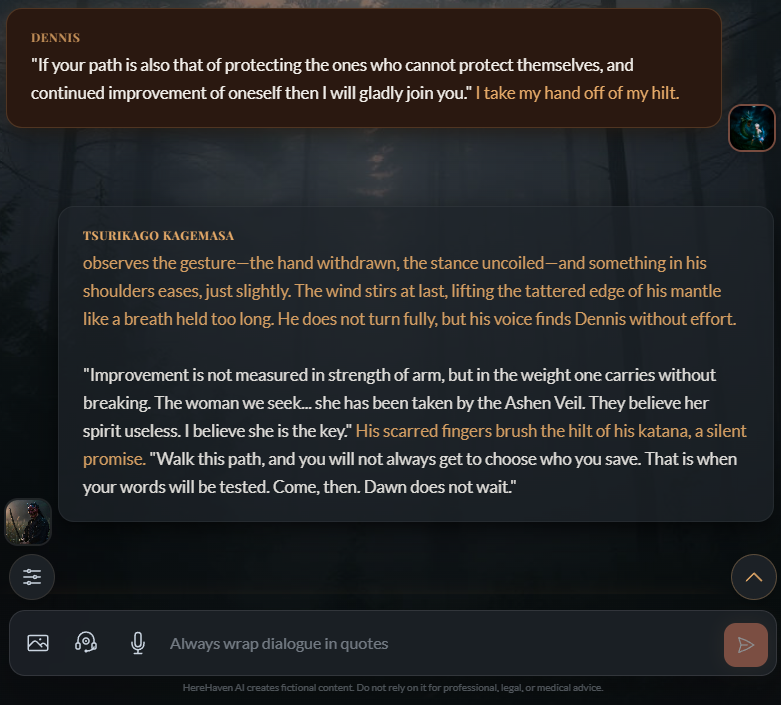
Open inside a scene
Scene openings work best when something has already changed and the user arrives at the moment a response matters.
Place the character, one concrete object, and one active change in the first two sentences instead of explaining the entire premise.
If the greeting could happen yesterday or next week without alteration, it lacks present tension.
Build the first image from facts the user can answer: a place, a changed object, and a character action. “The station clock stops; Inez slides over the log” establishes time, evidence, and intent in one beat. Avoid camera-like description of details that cannot affect a reply. In HereHaven preview, cover the character name and ask what is happening now. If the answer is only “someone introduces herself,” move the disruption earlier.
Offer a visible hook
A hook is a question, discovery, request, or complication the user can act on immediately.
Tie the hook to an observable detail and let the character’s motive determine why they care about the answer.
A mysterious adjective without evidence gives the user nothing to investigate.
Rate a hook by the verbs it offers. The warm ticket lets the user inspect, compare, deny, explain, hide, or return it. A line such as “something mysterious is happening” offers no equivalent action. Draft six plausible user verbs beside the greeting and ensure at least three lead to different information or costs. This check keeps the hook playable for cautious users as well as users who immediately follow the character’s request.
Protect user agency
A greeting may establish circumstances but should not dictate the user’s feelings, history, speech, or final choice.
Describe what the character does and what options are apparent; leave the user free to cooperate, challenge, inspect, delay, or leave.
Delete sentences that announce the user is terrified, agrees, remembers a shared childhood, or performs an action without consent.
Audit agency sentence by sentence. Highlight every “you” statement, then classify it as observation, optional invitation, or imposed fact. “Your ticket is warm” can be observed; “you remember printing it” assigns history; “you nervously enter” assigns emotion and action. Rewrite imposed facts from Inez’s perspective or convert them into questions. This method preserves a strong situation while leaving identity, relationships, feelings, and decisions under the user’s control.
Show character through action
A greeting should demonstrate voice and priorities instead of summarizing personality traits.
Replace labels such as clever or nervous with a line of dialogue, a physical choice, and a detail the character notices first.
If the opening says the character is cautious but has them trust a stranger instantly, behavior and description conflict.
Reveal personality with a sequence of noticing, choosing, and speaking. Inez notices the camera light, chooses the doorway with no view from the platform, and asks for the ticket number in chronological order. Those actions demonstrate caution and precision without naming either trait. Check that the sequence also serves the scene; a decorative gesture wastes scarce opening space. A useful greeting detail should characterize Inez and alter what the user can infer or do.
Control the information load
Readers need enough context to choose an action, not every fact in the character sheet.
Limit the opening to the current place, relationship assumption, immediate problem, and one unanswered detail; reveal older lore through later choices.
If the user must remember several names before replying, move those names out of the greeting.
Budget opening information by assigning one job to each sentence. Sentence one locates the stopped clock, sentence two shows Inez checking the log, and sentence three asks about the warm ticket. Move railway history, board politics, and the former engineer into clues that later choices can uncover. In preview, circle every proper noun and unexplained term. Keep only those needed for the first decision; unfamiliar names consume attention before the user has a reason to care.
Compare weak and strong versions
A weak greeting reports a premise while a strong greeting creates a decision point.
Read both versions aloud and underline concrete nouns, active verbs, and openings for user action; rewrite until the strong version needs a response.
The improvement should come from playable detail, not simply from adding more words.
Test alternate replies
A durable opening supports several plausible user responses without collapsing the intended scene.
Draft cooperative, skeptical, curious, and refusal replies, then confirm the character can answer each while keeping the hook alive.
If only one reply allows the story to continue, broaden the entry point rather than forcing compliance.