
Building Consistent AI Characters
Turn a character idea into a dependable performance guide without making every reply rigid.
6 min read · Updated
HereHaven Learn
Strong interactive stories begin with choices a reader can understand and a character who can respond without taking those choices away. This library turns that principle into practical work. You can use the guides to shape a character’s role, motives, voice, boundaries, and emotional range, then test those decisions in greetings and scenes that invite more than one believable response. Each article focuses on details you can inspect in your own HereHaven project rather than abstract promises about what a story might become.
The same discipline applies beyond a first message. Scenario guides show how objectives, stakes, locations, and changing objects keep a conversation moving. Memory and consistency guides explain what deserves to persist across chapters, how to spot contradictions, and how to repair drift without erasing earned character growth. Worldbuilding articles help connect lore to present decisions so readers discover a setting through action instead of receiving an encyclopedia before play begins.
Creative control also includes knowing where firm limits help. The publishing, moderation, voice, privacy, and constraint guides offer concrete review steps for public and private work. They distinguish useful canon from flexible performance, encourage original characters and settings, and keep personal information out of material that may be shared. These checks support imagination because everyone involved can see the boundaries of the scene and still find room for surprise.
Start with the article closest to your current obstacle. Draft a small example while you read, test it against cooperative and unexpected replies, and keep only guidance that changes an observable result. Later, combine related guides into a repeatable workflow: define the story goal, build the character, open a playable scene, track durable changes, and review the next chapter before continuing. The collection is designed for returning to a specific question whenever a project needs another careful pass.
Turn a character idea into a dependable performance guide without making every reply rigid.
6 min read · Updated
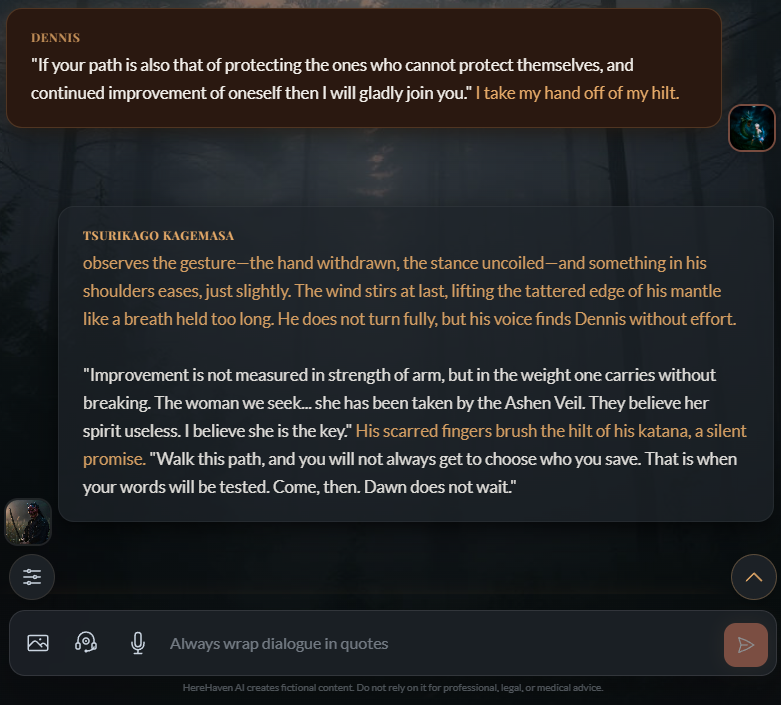
Make the first character message a playable opening rather than a biography dump or command.
5 min read · Updated
Notice, diagnose, and repair gradual changes that make an established character feel unfamiliar.
5 min read · Updated
Keep long stories coherent by recording what changes future decisions and discarding transcript noise.
6 min read · Updated
Build setting material that creates choices instead of burying roleplay beneath an encyclopedia.
5 min read · Updated
Choose what belongs in discovery, what stays private, and what needs review before sharing.
6 min read · Updated
Use multiple review layers and clear decisions to keep public discovery useful and accountable.
5 min read · Updated
Compare model behavior with repeatable scene tests instead of relying on labels or one impressive reply.
5 min read · Updated
Treat spoken roleplay as audible, sensitive data and choose the setting, content, and response accordingly.
4 min read · Updated
Give characters and users enough pressure to act while preserving several credible paths forward.
5 min read · Updated
Constrain continuity and boundaries while preserving multiple believable expressions and choices.
5 min read · Updated
Move from a story goal to a tested character conversation with continuity and safety checkpoints.
6 min read · Updated